framework
4 min read
Attribution Is a Liability Until You Test It
Attribution becomes dangerous when teams confuse credit assignment with proof. Once budgets get tight, that mistake pushes money toward channels that show up late in the journey and away from the work that created demand in the first place.
The mechanism
Google Analytics defines attribution as assigning credit across the touches that appeared before a key event. That is useful for reporting. It is not the same thing as proving causality. Google’s paid and organic last-click model still assigns 100% of the value to the final eligible channel. Even data-driven attribution remains a model of contribution built from observed paths, not a guarantee that the spend created net-new lift.[1]
100%
Last-click gives full credit to the final eligible touch
Useful for reporting, but not proof that the final touch caused the outcome.
Source: Google Analytics Help — Get started with attribution — Platform-defined reporting model, not an internal benchmark.
3.2x
Platform-reported conversions vs booked outcomes
Illustrative reconciliation gap from one audit window. The point is not the exact ratio. The point is that platform credit can overstate business outcomes by a wide margin.
Source: Internal audit pattern — Anonymized operator observation from reconciliation work across ad-platform and CRM reporting.
That distinction matters because most teams try to model on messy input. Google’s own campaign URL guidance recommends consistent UTM parameters so Analytics can collect campaign data correctly. In practice, teams rename campaigns mid-flight, links lose parameters, CRM stages update late, and one buyer shows up under multiple identifiers. Once the path is fragmented, the model looks rigorous while quietly scoring an incomplete journey.[4]
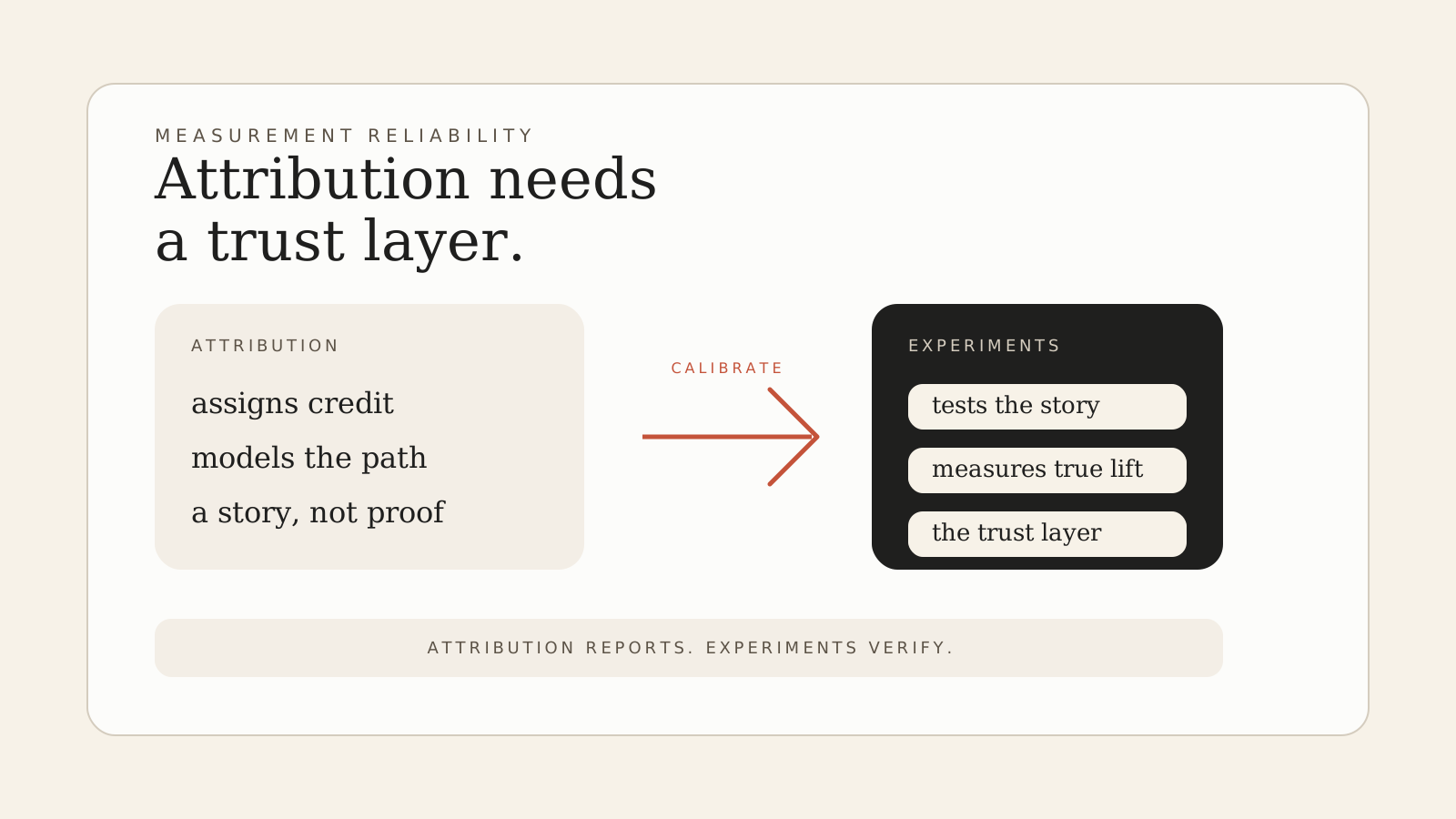
When you need to know whether a channel changed outcomes, you need an experiment. Google Ads experiments are structured around control and treatment arms so teams can compare performance, and Google’s experiment metrics explicitly include incremental conversions. That is the right calibration layer. Attribution tells you where credit landed inside the path you observed. Experiments tell you whether the spend changed the result.[2, 3]
What last-touch reported vs reconstructed first-touch reality
Source: Internal journey reconstruction — Anonymized audit example used to show how late touches can absorb too much credit.
In our own anonymized measurement audits, the operational pattern is consistent: platform-reported conversions run ahead of booked outcomes, branded and retargeting traffic absorb too much credit, and leadership ends up debating dashboards instead of reallocating budget. The problem is not that attribution is useless. The problem is that it sounds more certain than it is.
- 1
Reconcile source-of-truth totals
Pick one fixed week and reconcile analytics events, ad-platform conversions, and CRM opportunities. If the totals cannot survive scrutiny, stop modeling and fix instrumentation first.
- 2
Audit identity stitching quality
Run cohort checks for collision and split rates. Track observed versus inferred journey share so leadership can see where confidence falls off.
- 3
Run recurring holdouts
Test the highest-spend channels with recurring experiments or holdouts. Feed measured lift back into budget allocation instead of treating it as a side note.
The operating protocol
Start with instrumentation, not modeling. Standardize UTM usage, define ownership for campaign naming, and reconcile analytics, ad platform, and CRM totals on a fixed weekly window. If those numbers do not line up closely enough to survive a finance conversation, do not add more modeling.[4]
Then separate reporting from calibration. Use attribution for directional day-to-day decisions, but schedule experiments on the highest-spend channels to calibrate the model against observed lift. If the experiment says incremental conversions are materially lower than reported credit, treat that as a budgeting correction, not a footnote.[2, 3]
Allocation shift after holdout validation
Source: Internal budget recalibration pattern — Illustrative internal observation from teams that used experiments to reweight channel investment.
Finally, document the operating rules: attribution window, identity merge logic, what counts as a qualified conversion, and when the model must be revalidated. The win is not perfect truth. The win is a measurement system the growth lead, finance lead, and operator can all trust enough to act on.
Need an attribution stress test?
We map your measurement stack, run a fast integrity audit, and show exactly where model confidence is earned and where it is assumed.
Get an Attribution Stress TestFrequently asked questions
Last reviewed 2026-03-08
What is incrementality testing?+
Incrementality testing measures whether a channel changed outcomes or merely appeared on the path. The core setup is a control-versus-treatment comparison. That is why it is the right tool for calibrating attribution instead of replacing it.
What is the difference between an attribution model and incrementality testing?+
Attribution assigns credit across observed touchpoints. Incrementality testing uses experiments to estimate lift. Attribution tells you where credit lands. Incrementality tells you whether the spend changed the result. Most teams need both: attribution for directional reporting, experiments for ground-truth calibration.
What is UTM hygiene and why does it matter for attribution?+
UTM hygiene means using consistent campaign parameters across the URLs that feed your analytics system. When naming drifts or parameters disappear, your attribution model receives incomplete path data and the resulting report looks more reliable than it is.
How do you know if your attribution model is wrong?+
Start with three checks. Reconcile totals across analytics, ad platforms, and CRM. Look for suspiciously high credit on bottom-funnel capture channels. Then run an experiment or holdout on the highest-spend channel. If measured lift comes in lower than attributed credit, the model is overstating impact.
What is a holdout test in marketing?+
A holdout test withholds the campaign from one matched group while keeping it live for another. The difference between the two groups is your lift estimate. It is the clearest way to check whether a model’s assigned credit matches real-world impact.
How often should you validate your attribution model?+
Validate on a recurring schedule, especially for your highest-spend channels. Quarterly is a practical cadence for many teams because budget mix, campaign structure, and platform behavior move fast enough to make a stale model misleading.
References
[1] Google Analytics Help — Get started with attribution
Defines attribution, describes data-driven attribution, and shows how last-click assigns full credit to the final eligible touch.
[2] Google Ads API — Experiments overview
Documents experiment setup with control and treatment arms and comparing performance.
[3] Google Ads API — ExperimentMetric
Includes incremental conversions as an experiment metric.
[4] Google Analytics Help — URL builders: Collect campaign data with custom URLs
Explains UTM parameters and the recommended baseline campaign fields.
Read next
When you can’t trace revenue back to its source
Most teams know something is working. They just can’t prove which thing. Here’s how the attribution gap forms, and what to do about it.
Most marketing dashboards report activity, not impact
Most dashboards are built from available metrics instead of recurring decisions. That is how reporting turns into performance theater.
More data isn’t more clarity
You’re tracking everything and understanding nothing. Here’s how data abundance creates decision paralysis instead of insight.